پادشاهی آشور نو جغرافیای تاریخی- سیاسی آشور مرکزی تالیف عضو هیئت علمی دانشگاه هنر اسلامی تبریز
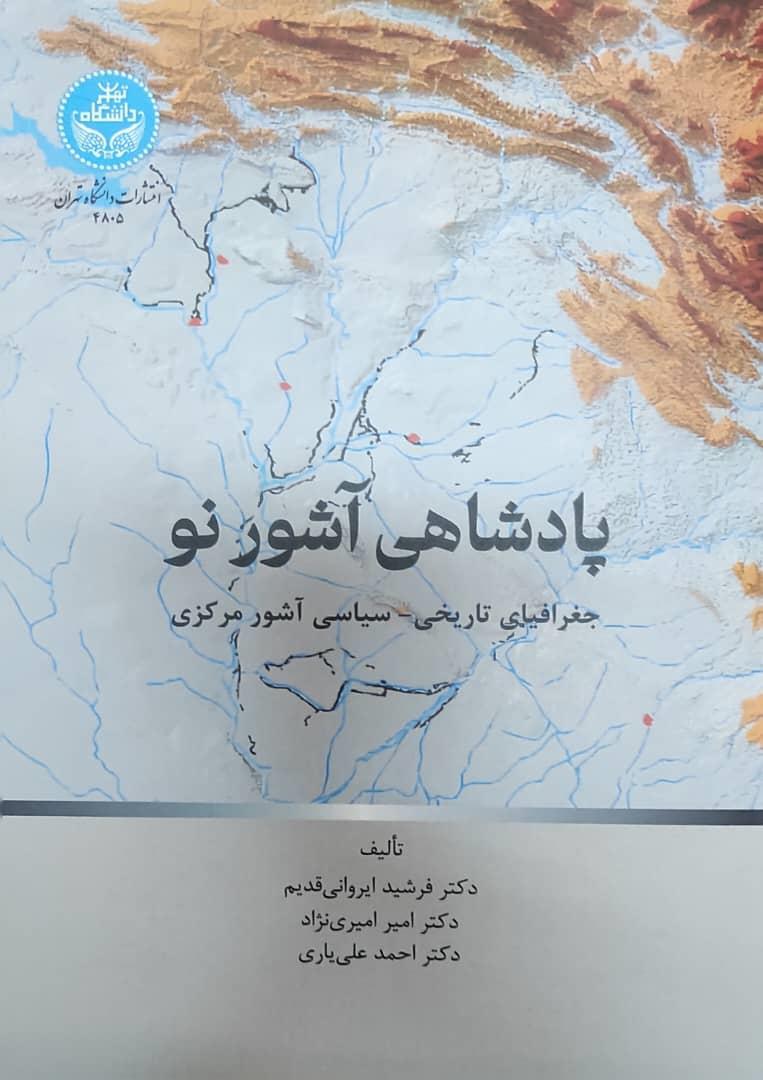
بدینوسیله انتشار کتاب عضو هیئت علمی دانشکده هنرهای کاربردی با عنوان "پادشاهی آشور نو جغرافیای تاریخی- سیاسی آشور مرکزی" در انتشارات دانشگاه تهران به اطلاع دانشجویان و علاقمندان میرسد.
مشخصات کتاب
عنوان: پادشاهی آشور نو جغرافیای تاریخی- سیاسی آشور مرکزی
مولف: دکتر فرشید ایروانی، دکتر امیر امیری نژآد ، دکتر احمد علییاری
ناشر: دانشگاه تهران
دریافت صفحات اول و خلاصه مبسوط فارسی [دانلود] دریافت صفحات اول و خلاصه مبسوط فارسی [دانلود]
The new-Assyrian Kingdom The Historical - Political Geography of Centeral Assyria
By Dr. Farshid Iravani Ghadim Dr. Amir Amiri Nejad Dr. Ahmad Ali Yari
Abstract In the early years of the first millennium BC, an unprecedented and significant phenomenon occurred in northern Mesopotamia that affected the entire Ancient East politically, socially, and militarily. This phenomenon was the creation of a single political structure called the Neo-Assyrian Kingdom and its core. The institution of kingship is an important part of ancient societies. The term “monarchy” means that sovereignty or supreme authority is symbolically vested in an individual. The three principles on which the foundation of this kingdom was based can be described as ideology, legitimacy, and implementation. Royal ideology was a fundamental component of the Neo-Assyrian monarchy, as it formed the foundation and principle of a belief system and allowed the elite group to justify their dominance over others. Legitimacy is also crucial because it adds to monopoly, thus allowing power to be concentrated in the hands of one individual. However, no system for justifying and concentrating power can be effective without the means of dissemination and enforcement. The Neo-Assyrian Kingdom was a large and expansive state that achieved a unified political structure. This government expanded its control based on policies such as conquest, coercion, or diplomacy. In doing so, it formed a codified political organization that encompassed a vast and culturally diverse region. Assyria was a hybrid state. To integrate the people and territories acquired through imperial expansion, the Assyrians created complex administrative systems that transcended political, social, ethnic, and local boundaries; but at the same time, Neo-Assyrian state was considered to have been exploitative. Most of the Assyrian state's efforts were aimed at controlling local populations, extracting resources from subjects and subordinate territories, and directing these resources to its main core (Central Assyria) for the economic benefits and political continuity of a very small segment of the population. The geography of Mesopotamia also profoundly shaped the way the region's inhabitants viewed the world around them, and the duality of the sense of “center” and “periphery” was formed in the early stages of their intellectual development. Although our initial understanding of the Neo-Assyrian kingdom often emphasizes its exploitative nature, there is abundant evidence for the integration of subject peoples into the Assyrian state. A number of scholars have also noted that many of the soldiers, scribes, administrators, and high officials in Neo-Assyria were not actually Assyrian. Assyria’s expansion was remarkably rapid and highly successful, but it was also met with long, stubborn, and in some cases successful resistance. At certain points in time, the anti Assyrian alliances arose as a response to Assyrian expansionism and military dominance. They are called “Kitro” in Assyrian sources meaning “a conspiracy between evil criminals with the aim of threatening”, which is a specialized ideological term in Neo-Assyrian literature. Ultimately, Assyria was eliminated from the scene of history by one of these alliances. The results obtained in this book, in addition to adding new components to Neo-Assyrian archaeology, are also expected to help identify the cultural and political presence of Neo Assyrians in the western regions of Iran for more than three centuries.
Keywords: Iron Age, Pottery, Neo-Assyrian Kingdom